

At a glance
Standardised tests help us measure your performance and current status. Based on this, we create a tailored programme to improve or maintain your performance.
Besides qualitative movement analysis, we also offer sport-specific performance testing and assessments before your return to sport, everyday life and work.
Test, understand, train
We measure what your body can really do, so that therapy and training focus exactly where you need them.
Pain-free doesn’t mean ready for full load.
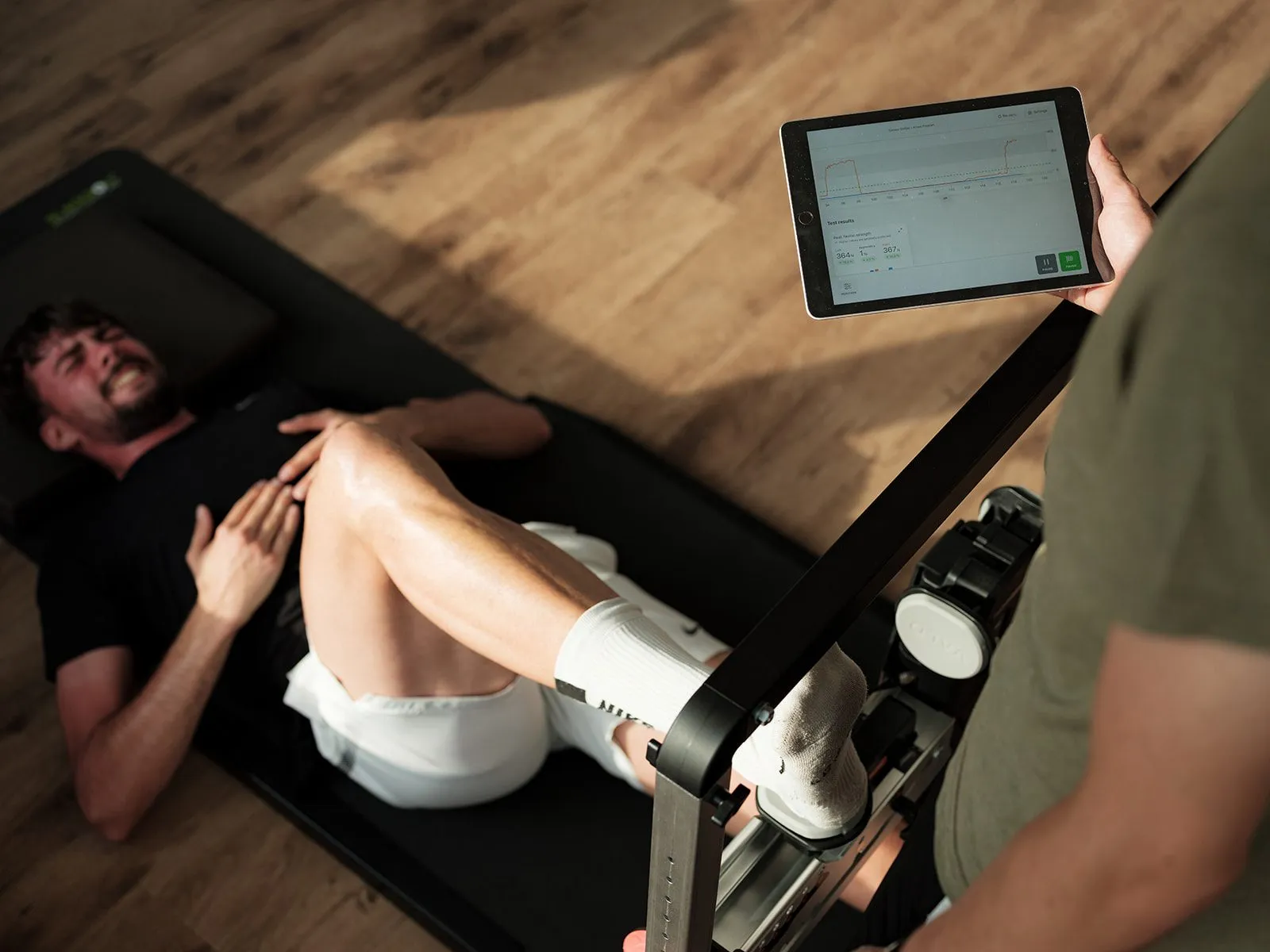
After an injury, but also through one-sided strain in sport or everyday life, strength differences between left and right often develop that you can’t feel yourself. It is exactly these differences that increase the risk of new or recurring injuries. Our measuring devices make them visible in just a few minutes – in clear numbers instead of gut feeling.
You get your personal report with clear charts. It shows your strength values on the left and right, the difference between sides in per cent, and where you stand compared with reference values for your age and sport.
We discuss every result with you directly. Afterwards you know exactly where you stand and what the next step is. On request, we also send the report to your doctor.
Preventive and in rehab
If you have no complaints, the test finds weak points before they become a problem. It’s a good fit for the start of the season or before you take on a new sporting goal.
Here the test replaces gut feeling with clear criteria. The question “When can I run, jump or ski again?” can then be answered with numbers. Repeated tests show your progress in black and white. That gives you confidence and motivation.
Hamstring strength
Single-leg jump height
After an injury, for example to the cruciate ligament, ankle or a muscle, we use a standardised series of strength, jump, speed and coordination tests to check whether your body can take full load again.
Afterwards you know not only whether you still have deficits, but exactly where – for example in jumping power or hamstring strength.
7 tests – one clear result!
What we offer
Seven tests – one clear result: RETURN TO SPORT!
Returning safely to sport after an injury is an important goal for competitive and recreational athletes alike. During rehabilitation, the question often comes up: “When can I run, hike, ski or play tennis again?”
While the first phase of healing is time-based and focuses mainly on healing the injured structures, the later phases of recovery are criteria-based. Experts now agree that a free range of joint movement alone is not enough to encourage someone to return to work or sport. After an injury, muscular and neuromuscular deficits play a particularly important role. They largely determine when a safe return is possible.
For this reason, doctors, physiotherapists and sports scientists jointly developed a standardised test battery to analyse patients’ deficits. This minimises the risk of re-injury and prevents a return that comes too early. The return to sport after injuries to the lower limbs, especially after ACL reconstruction, can be clearly defined and supported by objective test data.
The “RETURN TO SPORT” test battery consists of seven functional tests in the following areas:
The results of these tests show possible asymmetries (left–right comparison) and compare your performance with scientifically established reference values.
The test can be done at the end of the healing process, once squats and jumps have already been introduced in therapy. Talk to your therapist, who has detailed information about your specific case.
You are also welcome to contact us at any time.
To advise you even better, we have extended the existing evidence-based test battery with additional meaningful tests. We also test with devices such as the NordBord and the ForceFrame (see VALD Performance).
The tests take about 90 minutes. After a short warm-up, a therapist goes through the tests with you one by one and then discusses the results with you in detail. We are also happy to pass the results on to your treating doctor.
The aim is to identify potential deficits in mobility and stability through 5 standardised movement patterns, isolated mobility tests and a comprehensive analysis of the upper limbs.
Analysing your movement shows how symmetrically, balanced and rhythmically your body moves. It also helps us see whether your movement sequences are well coordinated and functional, or whether there are weaknesses, asymmetries or imbalances in mobility and strength. Qualitative movement analysis also lets us take each person’s individual needs and physical characteristics into account.
Based on these results, we develop an individual plan to correct possible limitations, improve movement and increase your well-being.
The movement analysis takes about an hour and, if you wish and we recommend it, is recorded on video by our therapists. This also makes it easier for you to understand how existing limitations affect your movement.
A qualitative analysis is possible for anyone at any time, and you don’t need to prepare for it. The more naturally you move, the clearer the link to how you move in everyday life – and the better for the analysis.
If you are currently injured and can only move to a limited extent, contact our therapists beforehand and we can focus on your individual needs.
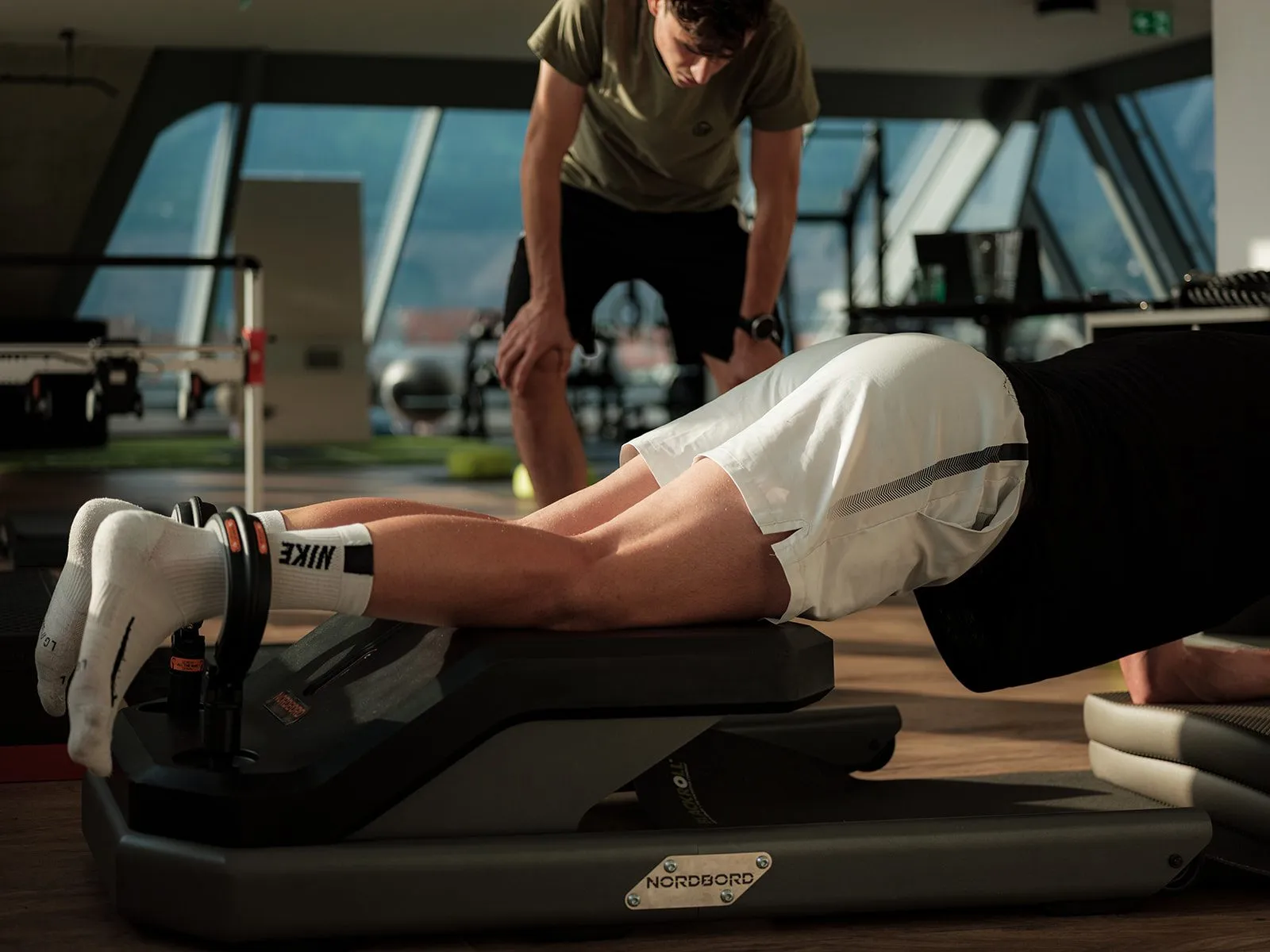
The NordBord is a simple and reliable device for measuring and training the strength of the hamstrings.
Hamstring strength is very important in many sports (team and winter sports) and also during rehabilitation after a wide range of muscle and ligament injuries. Measuring strength data is therefore important, both to identify possible imbalances and to assess the “return to sport”.
Physio 1.0 has therefore decided to include the NordBord in the RETURN TO SPORT testing to minimise the risk of re-injury when you return.
The ForceFrame is a biomechanical measuring and training device used for the comprehensive assessment of patients and athletes. Thanks to its versatile applications and precise strength measurement, we can make detailed statements about muscle strength and imbalances. This information helps us develop your individual rehabilitation programme, speed up your recovery and minimise the risk of injury from overload.
Physio 1.0 has therefore decided to include the ForceFrame in the RETURN TO SPORT testing to minimise the risk of re-injury when you return.
ForceDecks are force plates that measure ground reaction forces during movement. They provide a specific analysis of all types of jumps. They are used in elite sport as well as with patients and help document and manage your progress in therapy. Muscular deficits and asymmetries can be identified, helping to reduce the risk of injury from returning to sport too early.
The tests are carried out with our sports scientists as part of a therapy session. After a short warm-up and activation phase, the system is set up for you individually and the test is carried out. The results are then discussed.
Doing the tests regularly allows precise progress monitoring and adjustment of your therapy or training, which is why we recommend it.
This depends on the injury, how it is healing and the test format. Your treating therapist knows the details of your specific case and will take the appropriate steps – because you are at the centre of what we do.
Even if you are not currently in therapy, you can make an appointment with one of our sports scientists. We look forward to seeing you.
Your contact
Do you have questions about Testing? Get in touch directly – we’re happy to advise you.
Your central point of contact
For many people, an injury, complaints or pain in the musculoskeletal system mean a stressful, unusual situation. As your central point of contact, Physio 1.0 takes care of the whole coordination – so you can focus fully on your recovery.
“The highest quality is our standard”